
About The Compound
The Compound is a large, unfinished subdivision in southwest Palm Bay, originally planned for residential development but never fully built. Today, it consists mainly of paved roads and vacant lots, with limited infrastructure and an uncertain path forward.
Origins of “The Compound” in Palm Bay, Florida
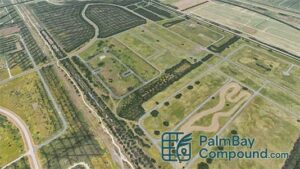
The area commonly referred to as “The Compound” in Palm Bay, Florida, began in the 1980s as an ambitious planned extension of Port Malabar. The land was owned and being developed by the General Development Corporation (GDC). As part of the plan, GDC established a rectangular street grid, similar to the layout of the borough of Manhattan in New York City.
The development, which passes through the scrubland of southwest Palm Bay—specifically within Port Malabar Units 51, 52, and 53—was slated to include thousands of quarter-acre residential lots.
However, in 1991, GDC declared bankruptcy. The project was abruptly halted. Accordingly, as part of the bankruptcy proceedings, the remaining land was liquidated, and large-scale development and home construction were never realized.
As a result of the failed attempt to develop, the present landscape of “The Compound” is characterized by an extensive stretch of paved roads and vacant homesites that remain mostly unoccupied.
Moreover, the area lacks essential utilities and a complete neighborhood infrastructure. According to municipal data and other sources, GDC constructed approximately 200 miles of roadway before the termination of the project.
The reported acreage associated with this area varies among sources, ranging from approximately 2,500 to 2,800 acres. Nonetheless, all sources concur that The Compound constitutes a vast, pre-platted expanse within the city limits of Palm Bay.
Liquidation & Fragmentation
The liquidation process resulted in fragmented ownership of land parcels in The Compound. Presently, the majority of parcels are owned by thousands of individuals dispersed across the country and internationally. However, the City of Palm Bay retains ownership of the paved roadways as well as some parcels of land in the area.
Zoning
Zoning regulations remain predominantly residential, reflecting the initial intention to develop a conventional subdivision. However, due to the absence of completed utilities or modern subdivision improvements, most development of residential lots has been dormant for decades.
This unfinished condition accounts for the near-abandonment of the subdivision. While the streets exist, the fundamental components of a neighborhood—such as water and sewer modalities, as well as providing electricity to each lot were never developed.
In addition, modalities such as signage, drainage, and coordinated development standards were never completed.
Reclaimed Lots: Revitalizing Idle Parcels
Over time, specific idle parcels of land have been "reclaimed" not by grading and construction, but through changes in title and ownership.
When property owners fail to pay their taxes, Brevard County has the authority to auction these properties through a tax deed process.
If any parcels remain unsold, they are added to a "lands available" list until a buyer is found. Investors and potential residents use these opportunities to acquire neglected lots, address existing liens, and restore responsible ownership practices.
In recent years, Palm Bay and its partners have sought funding for brownfields assessments to evaluate environmental conditions on selected tracts within “The Compound.”
These assessments serve as a prerequisite for future redevelopment or infrastructure planning and are often characterized as preliminary steps toward “reclaiming” underutilized land for productive use.
Significance of Historical Context
Understanding the origins of “The Compound” helps one understand the current condition of the area. It is a pre-platted subdivision lacking the requisite follow-through typical of fully developed neighborhoods.
The interplay of GDC’s bankruptcy, fragmented ownership, and absent infrastructure has given rise to an area comprised of thousands of vacant homesites and an extensive road system suffering from minimal development.
Current efforts focus on studying, consolidating, and, possibly, reclaiming parcels to make future infrastructure development a reality. This will allow stakeholders to turn a long-standing issue into a thriving community that ultimately realizes its initial potential.
Investment Assessment
Investors are likely to hold varied viewpoints regarding the acquisition and retention of property in “The Compound.” However, in general, the evidence shows that investors prioritize long-term scenarios in their strategic planning schemes.
Large investment entities with significant capital resources seem to represent the most promising candidates for purchasing, holding, and potentially realizing substantial returns on investments in “The Compound.”
However, smaller investment firms and well-capitalized individuals may also discover beneficial opportunities to acquire real estate in this area. Still, as with any investment, it is essential to assess the inherent risks carefully.
Lastly, individuals seeking to secure an affordable vacant lot to use as a home site in the future may also identify “The Compound” as an attractive option, as opposed to those who require land to build on NOW without understanding the possibility of having to wait a bit longer than expected.